


So you have a business idea that keeps you up at night. You're excited. You're convinced it could work. But before you pour your savings, time, and energy into it, there's one critical question you need to answer: does your market actually want what you're building?
Learning how to validate your business idea before investing is the smartest move any entrepreneur can make. Research from CB Insights found that 35% of startups fail because there's no market need for their product. That's not a talent problem or a funding problem. It's a validation problem.
This guide walks you through 10 practical steps to test your idea, reduce risk, and move forward with real confidence. Whether you're building a product, launching a service, or developing a digital platform, these steps will help you avoid costly mistakes and set your business up for long-term success.
Why Validating Your Business Idea Matters
Validation is not about doubting yourself. It's about gathering evidence before you commit serious resources.
A validated idea means you've confirmed that real people have a real problem, they're actively looking for a solution, and they're willing to pay for what you're offering. That's a completely different position to be in compared to building something in isolation and hoping customers show up.
The good news? Validation doesn't have to take months or cost a fortune. With the right approach and the right tools, you can get meaningful answers quickly.
Step 1: Identify and Understand Your Target Market
Before you validate your idea, you need to know exactly who you're validating it for.
Start by defining your ideal customer. Think about their age, location, income, job role, and daily challenges. What frustrates them? What goals are they chasing? What solutions have they already tried?
Creating a detailed buyer persona helps you stop thinking in generalities and start thinking about real people with specific needs. Tools like HubSpot's free persona builder make this process straightforward.
Be honest during this step. A common mistake is defining a target market that's too broad. "Everyone who uses the internet" is not a target market. "Freelance graphic designers earning $50,000–$90,000 per year who struggle with client communication" is.
The more specific you get, the more useful your validation data will be.
Step 2: Conduct Thorough Market Research
Once you know who your audience is, it's time to understand the landscape they live in.
Market research gives you a clear picture of:
- Market size: Is the audience large enough to build a sustainable business around?
- Market trends: Is demand growing, shrinking, or staying flat?
- Customer behavior: How do people currently solve the problem your idea addresses?
- Willingness to pay: What are people already spending money on in this space?
Use a mix of primary and secondary research. Primary research means talking directly to potential customers through surveys, interviews, or focus groups. Secondary research involves analyzing existing data from sources like Google Trends, Statista, and industry reports.
Don't skip the primary research. Numbers from reports tell you what's happening. Conversations with real people tell you why it's happening, and that's where the real insight lives.
Step 3: Analyze Your Competition
A market with competitors is actually a good sign. It means people are already paying for solutions in this space.
Your job is to understand what those competitors offer, where they fall short, and how you can position your idea differently.
Look at:
- Their pricing models
- Customer reviews (especially negative ones)
- Their website messaging and UX
- Their social media presence and engagement
- What keywords they rank for using tools like Ahrefs or SEMrush
The gaps you find in competitor offerings are your opportunities. If customers repeatedly complain that existing solutions are too expensive, too complicated, or too slow, that's a clear signal for how you should position your product.
Step 4: Build a Minimum Viable Product (MVP)
You don't need a finished product to start validating. You need a Minimum Viable Product, which is the simplest version of your idea that allows real users to experience its core value.
An MVP helps you test your assumptions without over-investing in features that may not matter. It could be a basic web app, a landing page, a prototype, or even a manual process that mimics what your product will eventually do automatically.
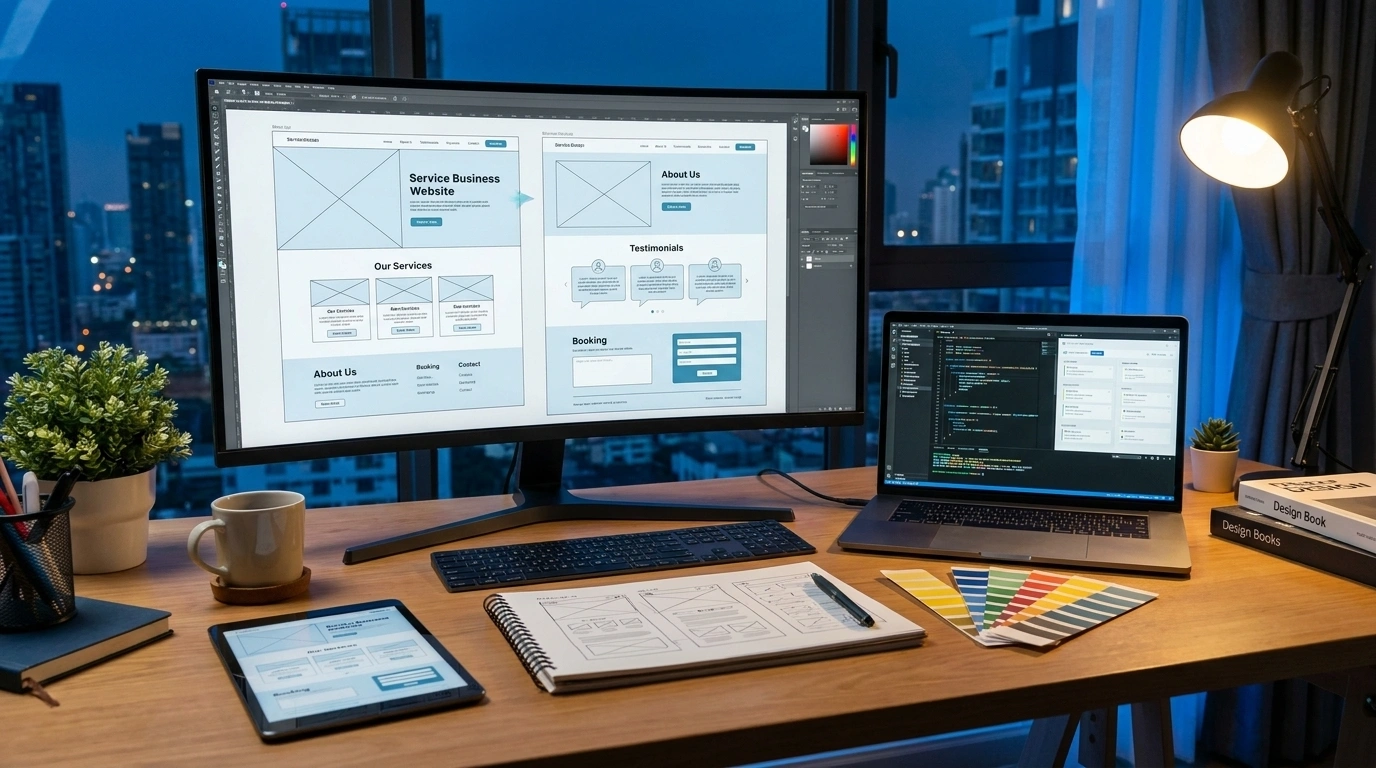
How Web Design and Development Supports MVP Launch
A well-designed, functional website is often your MVP's first impression. It needs to communicate your value clearly, load quickly, and guide visitors toward a specific action.
The team at Razen Creations LLC specializes in web design and development that brings MVPs to life fast. Whether you need a simple landing page or a fully functional web application, having a professional digital foundation builds immediate credibility with early adopters.
Step 5: Test Your Idea with Real Users
Getting your MVP in front of real users is where validation gets real.
Recruit a small group from your target market, anywhere from 10 to 50 people, and observe how they interact with your product. Pay attention to:
- Where they get confused or frustrated
- Which features they naturally gravitate toward
- Whether they complete the core action you want them to take
- What they say when you ask open-ended questions about their experience
User testing reveals things no amount of internal brainstorming will uncover. Real users will surprise you, and those surprises are worth gold.
The Role of UI/UX Design in User Testing
A poor user experience will distort your test results. If users struggle to navigate your product, you won't know whether they dislike the idea or just can't figure out how to use it.
Strong UI/UX design ensures your interface is intuitive, clean, and aligned with how your users think. Razen Creations LLC's UI/UX design services help startups and entrepreneurs build interfaces that users actually enjoy using, so your test results reflect real interest rather than usability frustration.
Step 6: Use Digital Marketing to Gauge Demand
Digital marketing is one of the most powerful and cost-effective tools for validating demand before you build anything at scale.
Here's how each channel helps:
SEO
Search volume data tells you how many people are actively searching for solutions to the problem your idea solves. If thousands of people search for terms related to your product every month, that's a strong signal of organic demand. Use Google Keyword Planner to explore this data.
PPC (Pay-Per-Click Advertising)
Running a small Google Ads or Meta Ads campaign is one of the fastest ways to measure real interest. You can spend as little as $200–$500 to drive traffic to a landing page and measure how many people take action.
Social Media
Posting about your idea, engaging in relevant communities, and measuring response rates gives you qualitative and quantitative signals about audience interest. Platforms like Reddit, LinkedIn, and niche Facebook Groups are especially valuable here.
The digital marketing team at Razen Creations LLC can help you design and run targeted campaigns that generate real validation data, not just vanity metrics.
Step 7: Validate Through Pre-Sales or Landing Pages
One of the strongest forms of validation is financial commitment. If someone gives you money before your product is fully built, that's a very clear signal of real demand.
Pre-sales can be structured as:
- Waitlist sign-ups with a small deposit
- Crowdfunding campaigns on platforms like Kickstarter or Indiegogo
- Early-bird pricing offered through a landing page
- Pilot program enrollment for a limited number of early customers
How a Professional Website Builds Trust
People won't hand over their email address, let alone their money, if your website looks untrustworthy or unprofessional. Your landing page needs to communicate credibility immediately.
This means clear messaging, strong design, fast load times, visible social proof, and a compelling offer. A well-crafted landing page built by professionals can be the difference between a failed pre-launch and a sold-out waitlist.
Step 8: Gather and Analyze Feedback
Collecting feedback is easy. Analyzing it properly is where most entrepreneurs fall short.
After your MVP launch or pre-sales campaign, gather feedback through:
- Structured surveys using tools like Google Forms or Typeform
- One-on-one interviews with early users
- Behavioral analytics using tools like Hotjar or Mixpanel
- Net Promoter Score (NPS) surveys to measure overall satisfaction
When analyzing feedback, look for patterns, not one-off opinions. If three people mention the same frustration independently, that's a signal worth acting on. If one person says something that contradicts ten others, treat it as an outlier.
Feedback should directly inform your next iteration. Build, measure, learn, and repeat.
Step 9: Assess Financial Viability
An idea can have genuine market demand and still fail financially if the numbers don't work.
Before moving forward, run through these core financial questions:
- Revenue model: How will you charge customers? Subscription, one-time payment, usage-based, or freemium?
- Unit economics: What does it cost to acquire one customer (CAC), and what is that customer worth over time (LTV)?
- Break-even point: How many customers or transactions do you need to cover your costs?
- Funding requirements: Can you bootstrap this, or do you need external investment?
Use a simple spreadsheet to model out your first 12–24 months under conservative, moderate, and optimistic scenarios. If the conservative scenario still shows a path to profitability, you have a financially viable idea.
Step 10: Know When to Pivot or Proceed
Validation doesn't always tell you to move forward. Sometimes it tells you to change direction, and that's an equally valuable outcome.
Signs you should proceed:
- Users are expressing genuine enthusiasm
- Pre-sales or sign-ups are exceeding expectations
- Your unit economics make sense
- You've identified a clear and defensible market position
Signs you should pivot:
- Users understand the problem but don't see your solution as the right fit
- Demand exists, but not at the price point you need to make it work
- A competitor already dominates the space with no clear opening for you
- Your target market is too small to build a sustainable business
A pivot isn't failure. Some of the most successful companies today, including Instagram and Slack, reached their current form only after pivoting from their original ideas.
How Razen Creations LLC Helps You Validate and Launch
Validating your business idea is just the beginning. Once you've confirmed there's real demand, you need the right team to help you build and scale.
At Razen Creations LLC, we work with entrepreneurs and growing businesses to turn validated ideas into market-ready products. Here's how our services support every stage of your journey:
Web Design and Development
We build fast, responsive, and visually compelling websites that make strong first impressions. Whether you need a landing page for pre-launch validation or a full-scale business website, our team delivers clean design with functional depth.
Custom Software and Mobile App Development
Once your idea is validated, we bring it to life through custom software and mobile applications built to your exact specifications. Our solutions are scalable, secure, and built for growth.
UI/UX Design
We design interfaces that users love. From wireframes to final mockups, our UI/UX design process is rooted in user research and usability testing, so your product works the way real people think.
Digital Marketing (SEO, PPC, Social Media)
We help you reach the right audience at the right time. Our digital marketing services cover SEO, paid advertising, and social media strategy, so you can drive traffic, generate leads, and convert them into customers.
eBook Publishing
If content is part of your business model or marketing strategy, our eBook publishing service helps you create professional, polished long-form content that builds authority and attracts your target audience.
Ready to take the next step? Contact the Razen Creations LLC team for a free consultation and let's map out your launch strategy together.
Frequently Asked Questions
1. How long does it take to validate a business idea?
It depends on the complexity of your idea and how quickly you can access your target market. A basic validation using landing pages and small-scale ads can be completed in 2–4 weeks. A more thorough process involving MVP development and user testing typically takes 2–3 months.
2. How much money do I need to validate a business idea?
You can validate many ideas for under $1,000. A simple landing page, a small paid ad campaign, and a few dozen customer interviews are enough to gather meaningful data. The goal is to spend the minimum necessary to answer your most critical assumptions.
3. What is the difference between market research and validation?
Market research tells you about the landscape, including size, trends, and competitors. Validation tests whether your specific idea has demand within that landscape. Both are important, and validation typically comes after you've completed your market research.
4. Can I validate an idea without building anything?
Yes. You can validate demand using a landing page, a pre-sales campaign, or even by manually delivering your service to a small group of early customers. The goal is to test whether people are willing to pay before you invest in full product development.
5. What if my validation results are mixed?
Mixed results are common and useful. Look at which aspects of your idea resonated and which didn't. Use that data to refine your positioning, adjust your target market, or modify your product offering before moving forward.
6. Is an MVP the same as a prototype?
Not exactly. A prototype is typically used for internal testing and demonstration purposes. An MVP is a working version of your product designed to be used by real customers in a real context. An MVP generates actual user behavior data, which is far more valuable than feedback on a demo.
7. How do I know when I've validated my idea enough to start building?
A good benchmark is reaching 3 of these 4 milestones: you've spoken to at least 20 potential customers, you've received at least 10 pre-orders or paid sign-ups, your unit economics show a viable business model, and you've identified a clear differentiator from existing competition.
Conclusion
Knowing how to validate your business idea before investing is one of the highest-leverage skills any entrepreneur can develop. It keeps you grounded in reality, protects your resources, and dramatically increases your chances of building something people actually want.
The steps in this guide give you a clear path from idea to evidence. Start with understanding your market, test early with real users, use digital marketing to measure real demand, and let the data guide your decisions.
When you're ready to turn a validated idea into a real product, Razen Creations LLC is here to help. From web design and development to custom software, UI/UX design, and digital marketing, we bring the technical and creative expertise you need to launch with confidence.
Work with Razen Creations LLC today and let's build something great together.