
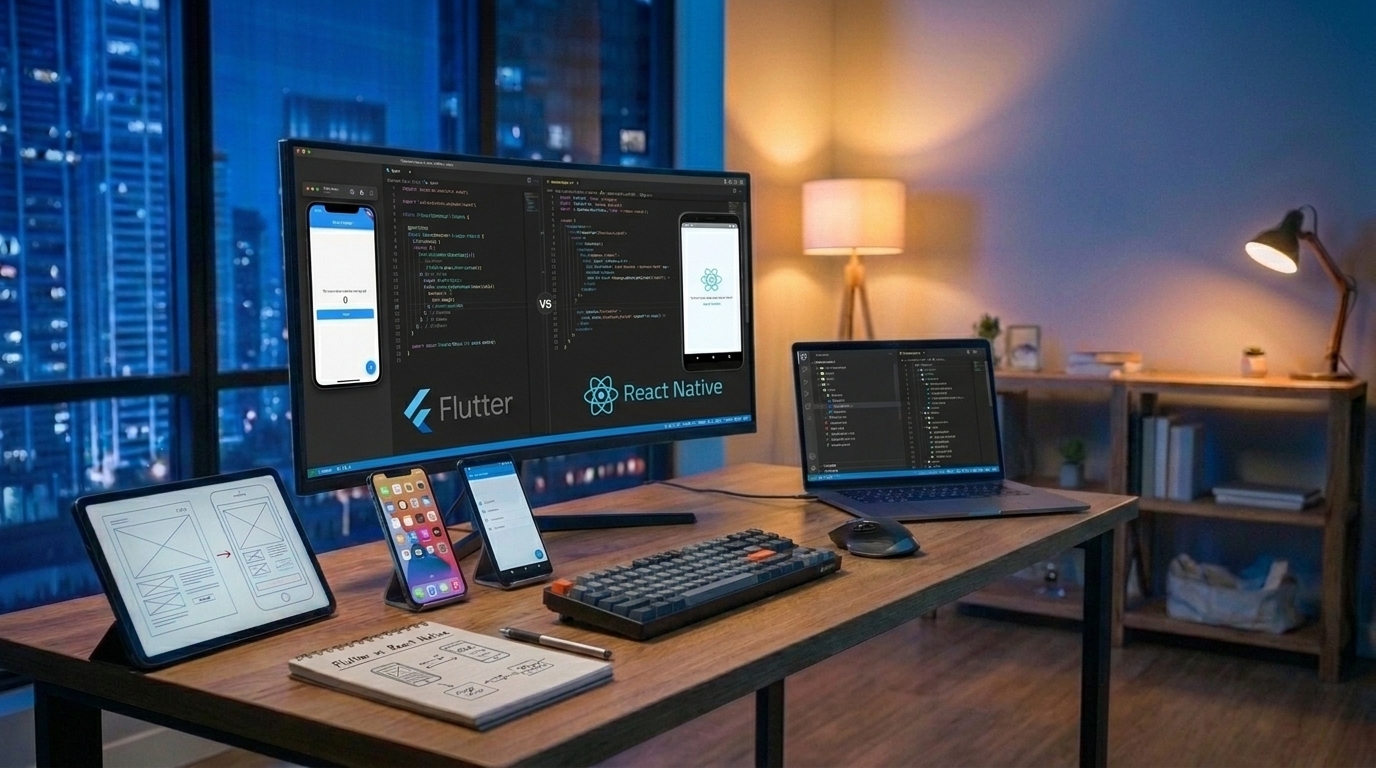
Picking the right framework is the biggest decision you will make before you write a single line of app code. Get it right, and you save money, ship faster, and delight users. Get it wrong, and you pay for it in bugs, delays, and expensive rebuilds later.
When people compare Flutter and React Native for app coding, they usually want one simple answer. The truth is a little richer. Both are excellent tools for cross-platform app development. Both let you build one codebase that runs on iPhone and Android. And both can produce beautiful, fast, business-ready apps.
In this guide, we break down what each framework is, how they differ, and exactly when each one wins. You will get real business use cases for startups, ecommerce brands, service companies, and enterprise teams. By the end, you will know which path fits your goals, your budget, and your growth plans.
Key Takeaways
- Flutter uses Dart and its own rendering engine, giving you pixel-perfect UI design and smooth, native-like performance.
- React Native uses JavaScript and React, making it easy for web teams to jump into mobile app development.
- Both support strong scalability, but your team's existing skills often decide the winner.
- Development speed, maintenance, and hiring costs matter just as much as raw app performance.
- The best choice depends on your project, not on hype.
What Is Flutter?
Flutter is Google's open-source framework for building apps from a single codebase. It launched in 2017 and has grown into one of the most loved tools in mobile app development.
Flutter uses a language called Dart. Instead of relying on the phone's built-in UI parts, Flutter draws every pixel itself using its own engine. That gives you total control over how your app looks on every screen.
Why teams choose Flutter
- Consistent UI design across iOS, Android, web, and desktop.
- Native-like performance thanks to compiled code and a fast rendering engine.
- Hot reload, which shows code changes instantly and speeds up development.
- One design, everywhere, so your app looks the same on every device.
If you want a polished, branded look with smooth animations, Flutter shines. You can learn more from the official Flutter documentation, which is clear and beginner-friendly.
What Is React Native?
React Native is Meta's open-source framework, first released in 2015. It lets developers build mobile apps using JavaScript and React, the same tools many web teams already know.
Instead of drawing its own components, React Native uses the phone's real native UI elements. This gives apps a genuine platform feel, and it is a big reason React Native became so popular for business app development.
Why teams choose React Native
- Familiar for web developers, since it uses JavaScript and React.
- Huge ecosystem of libraries and ready-made packages.
- Native components that match each platform's look and feel.
- Fast prototyping, which is great for startup app development.
The official React Native documentation is a great starting point if you want to see how the framework works in practice.
Flutter vs React Native for App Coding: Core Differences
Let's compare the two frameworks side by side on the things that actually affect your project.
This table gives you the quick view. Now let's dig into each factor so you can make a confident choice.
App Performance: Which Framework Feels Faster?
App performance is often the first thing people ask about. Slow apps frustrate users and hurt your reviews.
Flutter performance
Flutter compiles directly to native machine code. It does not need a bridge to talk to the device, so it handles heavy animations and complex screens smoothly. For apps with lots of motion, games, or rich visuals, Flutter usually delivers the best, most fluid experience.
React Native performance
React Native performs very well for most business apps. Older versions used a "bridge" that could slow things down, but the newer architecture removes much of that friction. For standard apps like ecommerce stores, booking tools, and dashboards, users will rarely notice a difference.
So what? For most business apps, both frameworks feel fast. Choose Flutter when you need heavy animations and pixel-perfect control. Choose React Native when your app is content-driven and speed to market matters more.
UI Design and Flexibility
Your app's look shapes how customers feel about your brand. This is where the two frameworks take different paths.
Flutter's UI strengths
Because Flutter draws everything itself, you get complete freedom over your UI design. Custom buttons, gradients, animations, and unique layouts are easy to build. Your app looks identical on every phone, which is perfect for strong, consistent branding.
React Native's UI strengths
React Native uses native components, so your app naturally matches each platform. iOS users get an iOS feel, and Android users get an Android feel. This is great when you want your app to blend in with the operating system.
Good UI is only half the story. Great UX keeps people coming back. If you want a design that converts, our UI/UX design services turn ideas into clean, easy interfaces. You can also avoid common pitfalls by reading our post on app design mistakes that drive users away.
Development Speed and Developer Experience
Fast development saves money and gets you to market sooner. Both frameworks are strong here, but in different ways.
Flutter developer experience
- Hot reload makes changes appear instantly.
- One codebase covers mobile, web, and desktop.
- Rich built-in widgets reduce the need for extra libraries.
Once your team learns Dart, building screens becomes fast and predictable.
React Native developer experience
- JavaScript familiarity means web teams start quickly.
- Massive library support speeds up common features.
- Reusable web knowledge, which lowers the learning curve.
If your team already builds websites, React Native offers the fastest onramp to mobile app development.
Reader checkpoint: Development speed often comes down to your team's current skills. Pick the framework that matches what your developers already know, and you will ship faster.
Ecosystem, Libraries, and Community
A strong ecosystem means fewer features you have to build from scratch.
React Native ecosystem
React Native has been around longer, so it has a deep pool of libraries, tools, and community answers. Need payments, maps, or push notifications? There is almost always a ready-made package.
Flutter ecosystem
Flutter's ecosystem is younger but growing quickly. Google backs it heavily, and its package library expands every month. For most projects, you will find the tools you need, and the quality is high.
Both communities are active and supportive. You will never feel stuck for long with either framework.
Testing and Code Quality
Reliable apps need solid testing. Bugs cost money and damage trust.
Testing in Flutter
Flutter offers strong built-in testing tools for unit, widget, and integration tests. Because Flutter controls the whole UI, tests behave consistently across devices.
Testing in React Native
React Native uses popular JavaScript testing tools like Jest. Web teams already know these tools, so writing tests feels natural. There are also great libraries for end-to-end testing.
Whatever you choose, testing should never be an afterthought. Learn why in our guide on why user testing matters and how it grows your business.
Maintenance and Long-Term Scalability
Your app is not a one-time project. It needs updates, new features, and ongoing care.
Flutter maintenance
- Stable API and strong tooling.
- One codebase means fewer places for bugs to hide.
- Google's steady updates keep the framework fresh.
React Native maintenance
- Frequent updates and a mature upgrade path.
- Huge community support for fixing issues fast.
- Easy to find developers who can maintain your code.
Both frameworks scale well for growing businesses. The key to smooth scalability is clean architecture from day one. That is where an experienced partner makes a real difference. Explore our custom software development services to build apps that grow with you.
Cost and Hiring: What to Expect
Budget matters, and so does your ability to find talent.
Hiring for React Native
JavaScript is one of the most common programming languages in the world. That means a large talent pool and often lower hiring costs. For startups watching every dollar, this is a real advantage.
Hiring for Flutter
Dart is less common, so the talent pool is smaller. However, Flutter developers are skilled and passionate, and the framework's productivity often balances out the cost.
The smart way to save money
You do not need to hire and manage a full in-house team. Working with an agency gives you senior talent without the overhead. See how we deliver value across projects on our services page, or check real results in our portfolio.
Real Business Use Cases
Theory is nice, but let's look at how this plays out for real businesses.
Startups and MVPs
Startups need to move fast and test ideas cheaply. React Native is often the best fit for a quick minimum viable product, especially if you already have web developers. Flutter also works beautifully when your MVP needs a standout, custom design.
If you are still shaping your idea, read our guide on how to validate your business idea before investing first.
Ecommerce brands
Ecommerce apps live or die by smooth browsing, fast checkout, and reliable performance. Both frameworks handle this well. Flutter gives you a polished, branded shopping experience, while React Native offers quick builds and rich payment libraries.
Pair your app with a strong online store. Our ecommerce website development service keeps your web and mobile experiences in sync, and our post on essential features every ecommerce website needs helps you plan ahead.
Service businesses
Booking apps, quote tools, and client portals help service businesses win more work. These apps usually favor speed to market, which makes React Native a great fit. Flutter is ideal when your brand needs a distinctive, memorable interface.
Before you build, review the top features every business app must have so nothing important gets missed.
Enterprise teams
Enterprises need scalability, security, and long-term maintenance. Both frameworks handle enterprise workloads, but the choice often depends on existing systems and team skills. Flutter suits teams that want tight design control, while React Native fits organizations already invested in JavaScript.
For complex needs, our enterprise software solutions help large teams build reliable, scalable apps.
When Flutter Is the Better Fit
Choose Flutter when:
- You want pixel-perfect, custom UI design and animations.
- Consistent branding across all devices is a priority.
- You plan to expand to web and desktop later.
- Native-like performance for heavy visuals matters most.
When React Native Is the Better Fit
Choose React Native when:
- Your team already knows JavaScript and React.
- You need to launch quickly with a lower budget.
- You want a large talent pool for hiring and maintenance.
- Your app is content-driven rather than animation-heavy.
Reader checkpoint: There is no universal winner. The best framework is the one that matches your team, timeline, and business goals.
How to Decide: A Simple Checklist
Use this quick checklist before you start:
- What skills does your team have now? Match the framework to them.
- How fast do you need to launch? Faster timelines often favor React Native.
- How custom is your design? Bold, unique designs favor Flutter.
- What is your budget? Factor in hiring and long-term maintenance.
- Where will you grow next? Consider web and desktop needs.
- Do you have a technical partner? The right team removes the guesswork.
If you are unsure, that is completely normal. This decision shapes your product for years. Talk it through with experts before you commit.
Why Partner With Razen Creations LLC
The framework is just the start. Great apps come from great planning, design, and execution. At Razen Creations LLC, we help businesses turn ideas into powerful mobile apps that customers love.
Here is how we support your journey:
- Mobile app development in both Flutter and React Native, matched to your goals.
- UI/UX design services that make your app easy and enjoyable to use.
- Custom software development for scalable, business-ready systems.
- Web design and development to keep your web and app experiences seamless.
- SEO services, PPC management, and social media marketing to help your app get found and grow.
- E-book design services if you want to build authority and educate your audience.
Want to know who you will be working with? Learn more about us, then get a free consultation to map out your app the smart way.
Conclusion
Both Flutter and React Native are outstanding choices for app coding in 2026. Flutter gives you total design control and smooth, native-like performance. React Native offers speed, a huge ecosystem, and an easy path for web teams. Neither is "better" in every case. The right pick depends on your team, budget, timeline, and growth plans.
Here is your next step: list your priorities using the checklist above, then match them to the framework that fits. If you want expert guidance from a team that has built apps for startups, ecommerce brands, service companies, and enterprises, work with Razen Creations LLC and build something your users will love.
Ready to start? Contact our team today.
Frequently Asked Questions
Is Flutter or React Native better for app performance?
Flutter usually edges ahead for heavy animations and custom visuals because it compiles to native code. React Native performs well for most business apps, especially with its newer architecture. For everyday apps, both feel fast.
Which framework is cheaper to build with?
React Native is often cheaper upfront because JavaScript developers are easy to find. Flutter can save money over time through its productivity and single codebase. Your total cost depends on features, design, and maintenance.
Can I build one app for both iPhone and Android?
Yes. Both Flutter and React Native support cross-platform app development, so you build one codebase that runs on iOS and Android. This saves time and reduces long-term maintenance.
Which is easier to learn for my team?
React Native is easier if your team already knows JavaScript and React. Flutter has a moderate learning curve because it uses Dart, but many developers find it fast and enjoyable once they start.
Which framework is best for startups?
Startups often choose React Native for quick, budget-friendly MVPs. Flutter is a strong choice when a startup needs a bold, custom design. The best fit depends on your timeline and team.
Will my app scale as my business grows?
Yes. Both frameworks support strong scalability when built with clean architecture. Planning for growth from day one is the key, which is where an experienced development partner adds real value.
How do I choose the right framework for my project?
Match the framework to your team's skills, budget, design needs, and growth plans. If you want expert help making the call, get a free consultation with Razen Creations LLC.